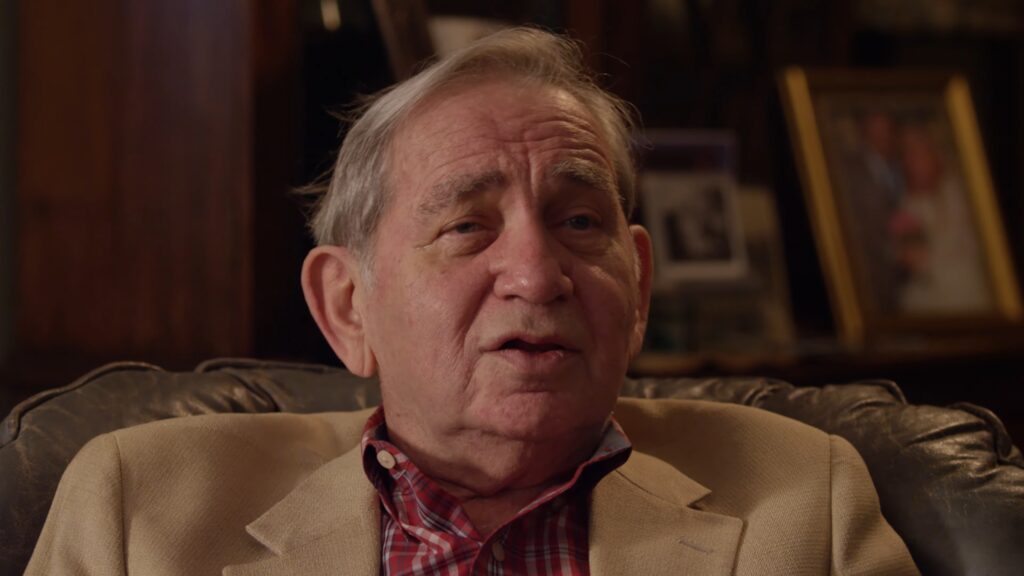
I want to write carefully about the work I am about to describe, because the rules of the work are part of the work.
For more than a decade, I have been recording long-form interviews with Holocaust survivors. The archive is private. It is held in trust for the families who entrusted me with the recordings. Most of the material is not — and may never be — for public release. A small, consented subset will appear in a short companion piece I am preparing for 2027, and only that subset.
This essay is not about the contents of the interviews. It is about the practice of doing them.
The promise
The first conversation with a survivor’s family is almost never about the camera. It is about the promise.
The promise is a quiet one. It is: I will record what your father (or mother, or grandmother, or uncle) wants to say. I will not edit it for entertainment. I will not put it on the internet without your permission. I will hand you a copy. I will keep a copy for as long as the family wants me to keep a copy. When the family wants the copy back, I will give it back. When the family wants me to release something, I will release exactly what is consented to and nothing more.
Some families never want anything released. That is also fine. The archive is for the family first.
This is, I have come to think, the only ethically defensible posture for testimony work involving survivors of catastrophic violence. The Shoah Foundation, which set the standard for this kind of work, has thought about this longer and harder than I have. So have the Fortunoff Video Archive at Yale and the USC Visual History Archive. The smaller, family-oriented projects — the ones that do not have an institutional brand — have to work even harder to keep the promise, because there is no institution behind us to remember it.
Why long-form
Most filmed testimony lives in clips. A two-minute clip of a survivor describing the day of liberation, a four-minute clip of a survivor describing the train. These clips, edited well, are powerful. They are also incomplete, often dangerously so.
Long-form is different. A four-hour interview is not just “the clip plus three hours and fifty-six minutes of context.” It is a different kind of artifact entirely. It captures things the clip cannot: the order in which a survivor returns to certain memories, the time spent on what now seems like a tangent and what turns out to be the heart of the story, the moments when the survivor pauses because the next sentence is hard. The pauses, in particular, are not negative space. The pauses are content.
Long-form is also the only way to honor a survivor who would like to talk about the rest of their life. Survivors are not people who survived; they are people who lived. They were children, then teenagers caught in catastrophe, then young adults rebuilding, then parents, then grandparents, then themselves at eighty or ninety. The clip culture wants the teenager in the catastrophe. The long-form record wants all of it. The survivor, in my experience, wants all of it.
The technique, briefly
I will not turn this essay into a how-to manual. But three notes, for filmmakers who are considering this kind of work:
Set up the day before. If you can, set up the room with the lighting and the camera at least twenty-four hours before the interview. Live with the room. Sit in the chair the survivor will sit in. Look at what they will look at. The day-of arrival with equipment, by itself, generates an atmosphere of performance, and performance is what you do not want.
Two cameras, no monitor. A wide and a tight, both on auto-iris, both recording continuously. No external monitor. Monitors create the wrong kind of self-consciousness — yours and the subject’s. If you need to check focus, do it once at the beginning, and then do not look at the cameras again.
Plan to come back. Tell the survivor, at the beginning of the day, that this is the first of however many sessions they want. Mean it. Some interviews end after four hours and never resume. Some go ten sessions. The work is for the survivor’s pace, not for the production schedule.
The technical part is not what makes a Holocaust testimony archive different from other documentary work. What makes it different is the part you cannot equipment-list: the willingness to spend a year, two years, sometimes more, with a single family, before you press the record button — and the willingness to honor the promise after the family stops needing anything from you.
Why it matters
The survivor cohort is, by the brute arithmetic of years, finishing. The people who were children in the camps are now in their eighties and nineties. The people who were young adults are gone. There will be a moment, soon, when the last living survivor of the camps dies. That moment will be one of the worst losses in modern memory, not because nothing has been recorded — a great deal has been recorded — but because the living, witnessed presence of the survivor in a room with a young person is irreplaceable.
What can be done is to record carefully now, with consent, and to keep faith with the families afterward. The films, if they are made at all, will be the smallest part of the work. The keeping is the work.
Lawrence Justin Mills is a documentary filmmaker. He writes at lawrencejustinmills.com.
Read next: – “Witnessing Carlos Mauricio”
Further reading – USC Shoah Foundation Visual History Archive — sfi.usc.edu/vha. – Fortunoff Video Archive for Holocaust Testimonies (Yale). – Lawrence L. Langer, Holocaust Testimonies: The Ruins of Memory (1991). – Geoffrey Hartman, The Longest Shadow: In the Aftermath of the Holocaust (1996).
About The Author

Originally published .