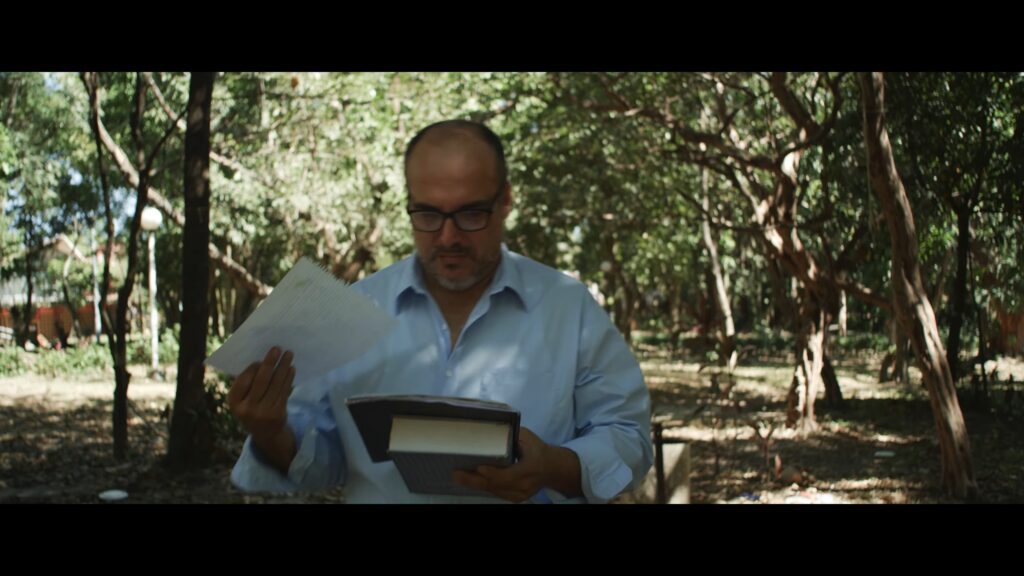
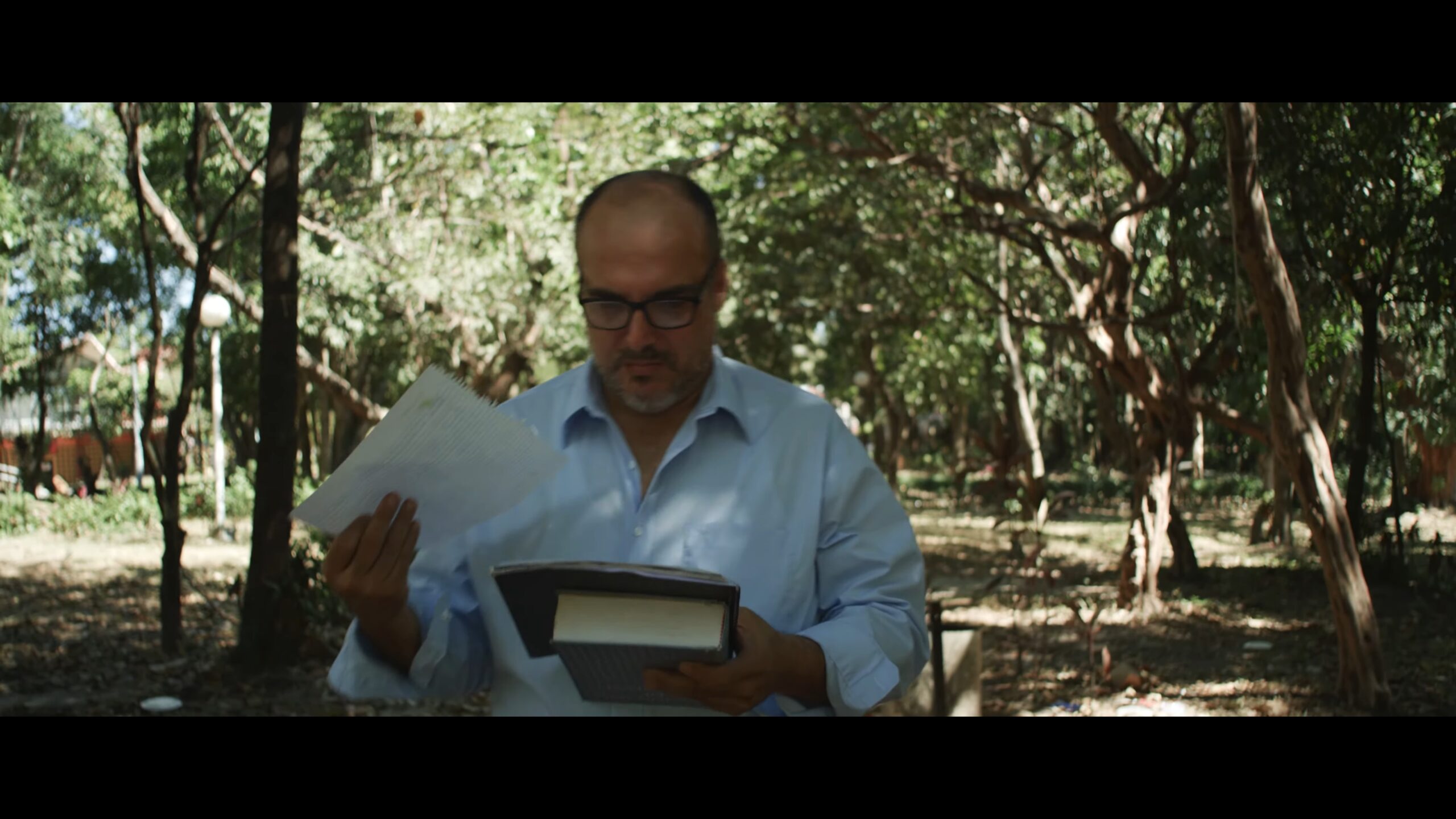
When I started filming Carlos Mauricio in 2008, the first lesson he taught me was that he was tired of being a story.
Carlos was a Salvadoran biology professor before the war. He taught at the University of El Salvador, in San Salvador. He cared about his students. He was not a guerrilla; he was a teacher. In June 1983, during the worst years of the Salvadoran civil war, Carlos was abducted from his classroom by men acting under the authority of the Salvadoran armed forces. He was taken to a clandestine site. He was held for nine days. He was tortured. The point was to make him into someone whose existence could be denied.
He survived.
For the next forty years, he refused to be denied.
The man, the campaign, the camera
When most Americans heard about Carlos for the first time, it was probably through the 2002 federal civil judgment in Romagoza Arce v. García, in which Carlos and two other survivors of Salvadoran torture sued two former Salvadoran defense ministers — Generals José Guillermo García and Carlos Eugenio Vides Casanova — who were then living in Florida. A jury found the generals liable. The Eleventh Circuit affirmed in 2005. Both men were eventually deported.
That case was historic for reasons that scholars of human-rights law will tell you about better than I can. What I want to write about here is something less reported. Carlos was not a litigant once. Carlos was a litigant always — but more than that, he was a witness always. He wrote books. He gave talks at universities. He went on radio. He served as the executive director of the Center for Justice and Accountability for a while. He went back to El Salvador, into the same rooms where his students had vanished, and he made his presence the answer to whether the rooms were going to stay empty.
When I asked Carlos if I could film him, what he said — and he said it gently — was: I’m tired of being a story. But I’m not tired of telling the story.
That sentence, I now realize, is the entire job description of a documentary filmmaker.
The patience of the camera
Filming Carlos was the slowest work I had ever done. Two hours of setup. Forty minutes of warm-up. An hour and a half before he would say anything that wasn’t well-worn. And then, sometime in the third hour, he would start telling something he had never told a microphone before — not because the microphone earned it but because he had decided.
It changed how I think about the camera.
There is a temptation, when you make documentaries, to believe that the camera extracts. You point it; you ask the question; you receive the answer. This is the model that builds reality television and most cable news. The camera is a probe.
It is not. It is a witness. Like any witness, what it sees depends on whether it is willing to stay long enough to see anything worth seeing. The probe gets the version of the story the subject already had ready. The witness gets the version of the story that needed two more hours to come out.
Two more hours costs money. Two more hours costs the subject’s energy. Two more hours requires the filmmaker to be quiet, to drink the water that the subject’s daughter brought from the kitchen, to ask the boring follow-up question and then to let the room be silent until the better answer arrives.
What I learned from Carlos — what El Camino de la Sombra is built around, frame by frame — is that the better answer always arrives. You have to wait for it.
What the film is about
The Path of the Shadows is not a film about Carlos’s torture. There are several films about Carlos’s torture. They are good films and you should watch them, especially Justicia Ahora, the documentary that came out of the Romagoza case.
The Path of the Shadows is a film about what Carlos did with the forty years between his nine days in a basement and his death from cancer in 2020. The film is about a teacher who refused to stop being a teacher even when his country tried to erase him. It is about what it means to spend a life telling a story that the world has decided is over.
I do not know if I have done Carlos justice. I have done my best. The film has been screened privately for his family and his closest collaborators, and they have given me their notes, and I have taken them. I produced it in 2018.
Why this is the work I do
Every documentary filmmaker is asked, sooner or later, why they make the films they make. I have noticed that the people who give the most honest answers tend to give the shortest ones.
Mine is: because most stories don’t get told twice. If you don’t tell the story carefully the first time, somebody else will tell it carelessly the second time, and the second time will be the one that sticks. I would rather spend three hours waiting for a man to find his words than three years arguing on the internet about whose summary of those words was better.
Carlos understood that. He also understood that the camera was an instrument like any other. It rewards the patient. It punishes the rushed. And — here is the part I am still learning — it is more useful when it is borrowed from a person rather than aimed at a person.
I miss Carlos. I think about him every time I sit down to work on the film. I am very lucky to have known him.
Lawrence Justin Mills is a documentary filmmaker. His feature The Path of the Shadows (El Camino de la Sombra) is in extended-trailer release. He writes at lawrencejustinmills.com.
Read next: – “Preserving Testimony: Notes on a Holocaust Archive”
Further reading – Romagoza Arce v. García, 434 F.3d 1254 (11th Cir. 2006). – Carlos Mauricio, Justicia o muerte (memoir, in Spanish). – The Center for Justice and Accountability, www.cja.org. – Salvadoran Truth Commission, From Madness to Hope (1993).
About The Author

Originally published .